

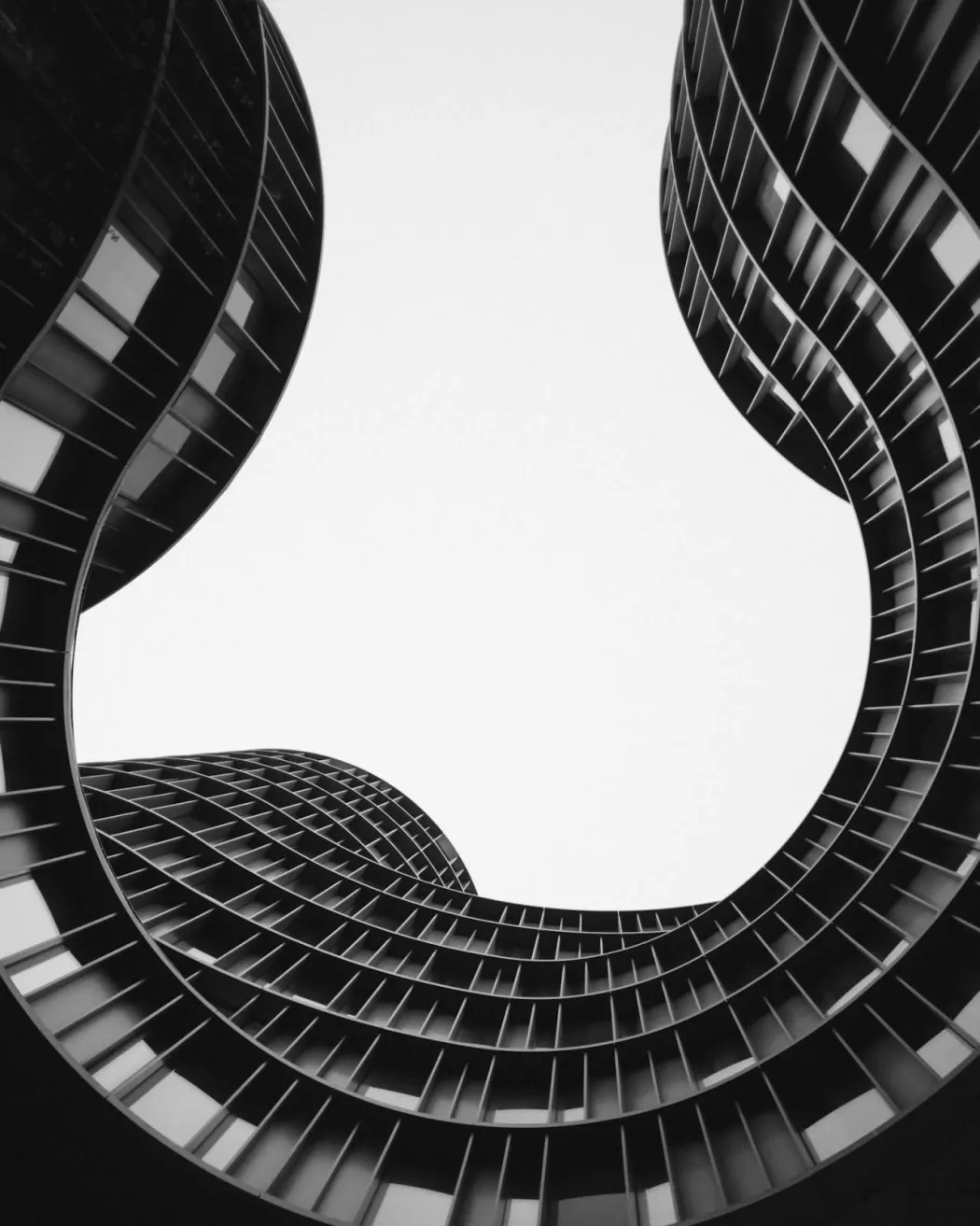
Most people walk past buildings without a second glance. Architectural photographers do the opposite: they stop, tilt their heads back and look for the shapes hidden in steel, glass and concrete. Some of the most striking images of the past year have come from photographers who simply pointed their cameras straight up.
“From below, a building stops being a building,” says Chicago photographer Mira Svensson. “It becomes lines, curves and rhythm. It becomes abstract.”
Finding The Shot
Svensson spends hours walking around a building before taking a photo, watching how light changes across its surfaces. Curved facades, like the dramatic twisting towers of Copenhagen’s waterfront, are among her favorite subjects because the shapes change with every step.
Advertisement
She recommends a wide-angle lens, between 16mm and 24mm, to capture dramatic perspectives, and shooting on overcast days when soft light reveals detail without harsh shadows. Black-and-white conversion can emphasize form and texture.
Timing can make a dramatic difference. Early morning and late afternoon light skims across facades, revealing texture and creating long shadows. Midday light is harsh, but it can work well for high-contrast black-and-white images. Svensson also recommends returning to the same building in different seasons and weather conditions. “A building looks completely different in fog, snow or golden light,” she says. “Each visit reveals something new.” She keeps a notebook of locations and the best times to photograph them, a habit she says has helped her capture some of her most popular images over the past several years.
Composition Tips
Symmetry is powerful, but so is deliberate imbalance. Svensson often places a curve or a corner off-center to create tension. Including a patch of sky gives the eye a place to rest. “Negative space is as important as the building itself,” she says.
Many architectural photographers share their work online with location tags, which has turned some buildings into destinations for photography fans. Svensson encourages beginners to start locally. “Every city has interesting architecture,” she says. “Parking garages, libraries, apartment blocks. Look up, and you will be surprised by what you find. The best photographs are often hiding in places you walk past every single day.”
Advertisement